Project Management
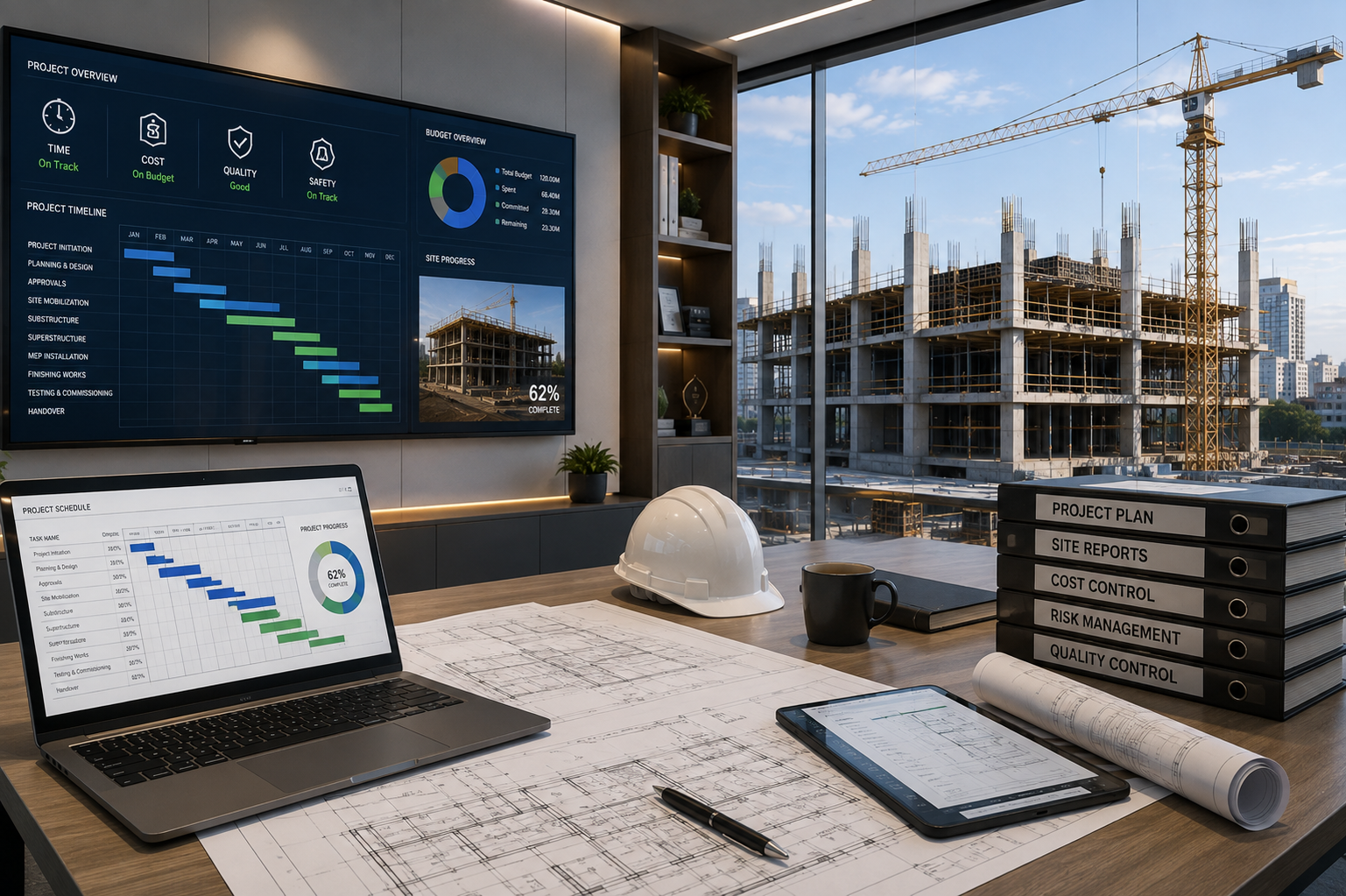
Keeping every discipline moving on the same schedule.
Everything You Need To Know
ACCO Private Limited, operating publicly as ACCO Pakistan, is a multidisciplinary architecture, engineering, and construction firm headquartered in Rawalpindi, with additional studios in Lahore, Karachi, and Faisalabad. Founded in 2009, ACCO has grown from a small structural engineering practice into a full design-build company that has delivered over 100 projects across Pakistan's commercial, healthcare, industrial, residential, and institutional sectors.
What sets ACCO apart in Pakistan's fragmented construction industry is a single-firm accountability model: architecture, structural and MEP engineering, interior design, and construction management all sit under one roof, working from the same drawings and the same schedule. Clients get one point of contact and one team that can't blame the "other contractor" when something goes wrong — because there is no other contractor. You can read more about our history, leadership, and values on our About Us page.
What Is Project Management?
Construction project management is the discipline of coordinating every party involved in delivering a building — architects, engineers, contractors, and suppliers — against a single master schedule, budget, and quality standard. Even well-designed, well-built projects can fail commercially if the parties involved aren't coordinated toward the same program, and project management exists to prevent exactly that failure.
ACCO Pakistan offers independent project management as a standalone service, distinct from our construction management offering. Where construction management is about running our own site team, project management is about representing the client's interests across every party on a project — including firms other than ACCO.
What Our Project Management Service Includes
- Master schedule development, integrating design, procurement, and construction milestones
- Budget tracking and cost reporting across all project disciplines
- Coordination between independently engaged architects, engineers, and contractors
- Change order review and approval workflow
- Risk identification and mitigation planning
- Client representation in site meetings and design reviews
- Final account reconciliation and project close-out
This service is particularly valuable for clients who have already engaged an architect or contractor independently and want an experienced, accountable party overseeing the overall program on their behalf.
Independent Oversight, Not Just Coordination
The core value of engaging ACCO as project manager on a project we did not design or build is independence. Our project managers act purely in the client's interest, reviewing design decisions, contractor performance, and cost claims without the conflict of interest that comes from also being the firm that produced the work being reviewed.
This is especially valuable for clients managing complex projects with multiple independent consultants, where no single party naturally has visibility across the entire program. Our project managers provide that missing visibility, translating technical progress into clear reporting a client can actually use to make decisions.
Managing Risk Across a Project
Every construction project carries risk — design risk, cost risk, schedule risk, and contractor performance risk. Our project management approach treats risk identification as a continuous activity, not a one-time exercise at project kickoff. We maintain a live risk register throughout the project, flagging emerging issues — a supplier delivery slipping, a design query taking too long to resolve, a subcontractor underperforming — before they compound into serious schedule or cost impacts.
This proactive approach draws on established project management principles similar to those maintained by international bodies such as the International Facility Management Association, adapted specifically to the realities of managing construction projects in Pakistan.
Cost Reporting Built for Decision-Making
Many project cost reports are built for accounting purposes — useful for reconciling invoices, but not for helping a client decide anything in real time. Our project management cost reports are structured differently: they show budget position against forecast at any given point, flag variances as they emerge, and translate technical cost data into a format a non-technical client stakeholder can act on quickly.
When to Engage Independent Project Management
- You've engaged an architect and contractor separately and want independent oversight of the overall program
- Your project involves multiple buildings or phases requiring coordinated scheduling
- You need clear, decision-ready cost and schedule reporting for stakeholders or investors
- You want an experienced party managing risk and change orders on your behalf
Project management can also be combined with our other services — for example, overseeing a project where ACCO also provides architectural design but a separate contractor handles construction.
Typical Timeline & Cost Factors
Project management is typically engaged for the full duration of a project, from early design through final handover, though it can also be brought in mid-project if a client needs to regain control of a program that has drifted off schedule or budget. Fees are usually structured as a percentage of overall project value or as a fixed monthly retainer, depending on project complexity and duration.
Common Project Failures Independent Oversight Prevents
Projects without independent project management often fail quietly, not dramatically — a schedule that slips two weeks here and three weeks there until a six-month delay becomes undeniable; a budget that drifts through unreviewed change orders until the final account bears no resemblance to the original estimate; a dispute over design intent that festers for months because no single party has the authority or independence to resolve it.
Our project managers are trained to catch these slow failures early — reviewing schedule updates critically rather than accepting optimistic contractor reporting at face value, scrutinizing change order justifications before they're approved, and stepping in as a neutral technical authority when design and construction parties disagree on intent.
Reporting Tools & Client Communication
We structure project reporting around the decisions a client actually needs to make, not around presenting the largest possible volume of data. A typical monthly report covers overall program status against baseline, budget position with variance explanations, top risks and their mitigation status, and any decisions pending from the client. For larger or investor-facing projects, we can tailor reporting cadence and format to match stakeholder requirements, including board-ready summary formats.
Our Project Management Team
Our project managers bring backgrounds in construction management, structural engineering, and architecture — not generic project administration — which means they can engage substantively with technical claims from contractors and consultants rather than simply relaying information between parties. This technical depth is what allows our project managers to add genuine value beyond scheduling software, catching engineering and construction issues that a purely administrative project manager would miss entirely.
What to Expect Working With Our Project Management Team
Engaging ACCO for independent project management typically begins with a diagnostic review of the project as it currently stands — existing schedule, budget baseline, contracts in place, and any known issues — whether we're joining at project kickoff or stepping into a project already underway. This diagnostic gives both us and the client an honest, shared starting point rather than assuming everything documented to date is accurate and complete.
From there, we establish a reporting rhythm matched to the project's complexity and the client's decision-making needs — weekly for fast-moving construction phases, monthly for steadier design or planning phases. Every report is built around flagging what needs a decision, not just what has happened, since the value of project management is in surfacing issues while they're still cheap to fix, not documenting them after the fact.
When disputes arise between design and construction parties — and on any sufficiently complex project, they eventually do — our project managers act as an informed, independent voice grounded in the actual drawings and contracts, not just diplomatic mediation without technical substance. This technical credibility is often what allows disputes to resolve in days rather than escalating into weeks of unproductive back-and-forth.
Coordinating Multi-Party Projects in Pakistan
Projects involving multiple independently engaged firms — a separate architect, structural engineer, and contractor, for instance — carry coordination risk that grows with every additional party involved, particularly where firms have no prior working relationship with each other. Our project managers are experienced specifically in bridging these gaps: establishing clear communication protocols between parties, resolving ambiguous scope boundaries before they become disputes, and maintaining a single source of truth for project status that all parties reference rather than each firm working from its own version of events.
This coordination role becomes particularly valuable on projects with international components — imported equipment, foreign design consultants, or overseas investors requiring regular reporting — where local project management with genuine cross-cultural and cross-firm coordination experience meaningfully reduces friction.
Contract Administration & Claims Management
Beyond schedule and cost tracking, effective project management includes careful contract administration — ensuring payment applications match verified work completed, reviewing extension of time claims against actual documented delay causes rather than accepting contractor assertions at face value, and maintaining the correspondence and documentation trail that protects a client's position if a dispute ever needs formal resolution. This administrative discipline is often the least visible part of project management day-to-day, but it's frequently what determines whether a dispute resolves quickly and fairly or drags on for months with neither party able to substantiate their position.
Our project managers maintain thorough records throughout a project specifically so that, if a claim or dispute does arise, the client has a clear, well-documented position rather than having to reconstruct project history from scattered emails after the fact.
Stakeholder & Investor Reporting
For projects backed by investors, lenders, or multiple stakeholder groups, project reporting often needs to serve an audience beyond the immediate client team — board members, financing partners, or joint venture participants who need confidence in project status without wanting to review granular construction detail. We build tailored reporting formats for these audiences, translating technical project status into the financial and risk-focused summaries that investment stakeholders actually need to make their own decisions, while maintaining the detailed technical reporting the operational client team requires.
Procurement Strategy & Vendor Selection Oversight
Procurement decisions on complex projects often carry more long-term cost impact than any other single category of decision, yet they're frequently made under time pressure without structured evaluation. Our project managers develop procurement strategies appropriate to each project — determining which packages benefit from competitive tendering versus negotiated procurement with a pre-qualified vendor, and structuring evaluation criteria that weigh technical capability and delivery reliability alongside price, rather than defaulting to lowest-bid selection that frequently costs more in the long run through delays and quality issues.
We also provide independent oversight of vendor and subcontractor selection when a client's own team lacks the technical background to evaluate competing technical proposals confidently, ensuring procurement decisions are made on genuine merit rather than the most persuasive sales presentation.
Quality Assurance Oversight Across Project Disciplines
Independent project management includes quality oversight that spans across disciplines, catching issues that fall through the gaps between an architect's design review, an engineer's technical sign-off, and a contractor's self-certified quality control. Our project managers conduct periodic cross-disciplinary quality reviews throughout a project, verifying that the built work genuinely matches design intent and specification — not simply trusting that each party's individual quality process is sufficient on its own.
This is particularly valuable on projects where design and construction are handled by different, independently engaged firms with no natural incentive to flag each other's shortcomings, since a truly independent project manager has no such conflict of interest in raising quality concerns candidly.
Project Management for Renovation & Expansion Projects
Renovation and expansion projects on occupied buildings carry coordination demands that new-build projects don't — balancing ongoing operations against construction activity, sequencing works to minimize disruption, and managing the additional risk that comes from unknown existing conditions revealed only once work begins. Our project managers bring this specific experience to expansion and renovation engagements, having coordinated projects including a phased hospital expansion delivered without disrupting patient care, building a realistic risk and contingency plan around the genuine uncertainty that comes with working on and around an existing occupied structure.
Why Choose ACCO Pakistan for Project Management
Our project managers bring direct construction and engineering experience, not just scheduling software expertise — which means they understand the technical substance of what they're reviewing, not just the paperwork around it. That experience comes from delivering our own design-build projects across commercial, healthcare, and industrial sectors, visible on our projects page.
Because our project managers have sat on the other side of the table as designers and builders themselves, they know precisely which claims from a contractor or consultant deserve scrutiny and which are genuinely routine — a distinction that saves clients from both unnecessary conflict and costly oversights. This is a level of technical grounding that generic project management consultancies without construction delivery experience of their own simply cannot offer.
Learn more about our team on our About Us page.
Start Your Project Management Engagement
Contact our project management team to discuss oversight for a project already underway, or planning support from the start.
Benefits
Independent oversight
We can manage projects designed or built by other firms, giving clients an independent check on progress and cost.
Single master schedule
Every discipline is coordinated against one program, reducing the delays caused by siloed planning.
Proactive risk management
Risks are flagged and mitigated before they become schedule or cost overruns.
Clear cost reporting
Clients receive cost reports built for decision-making, not just record-keeping.
Our Process
Program Setup
A master schedule and budget baseline are established across all disciplines.
Coordination
Weekly coordination between architects, engineers, and contractors against the program.
Reporting
Regular cost, schedule, and risk reporting to the client.
Close-Out
Final account reconciliation and documentation handover.
Self-Managed Project vs. ACCO Project Management
| Factor | Self-Managed by Client | ACCO Project Management |
|---|---|---|
| Cross-discipline coordination | Client coordinates architect, engineer, contractor directly | Single accountable coordinator across all parties |
| Risk visibility | Reactive — issues surface late | Proactive — live risk register |
| Cost reporting | Raw invoices and estimates | Decision-ready budget vs. forecast reporting |
| Change order review | Client evaluates technical claims directly | Independent technical review before approval |
| Time commitment from client | High — client is the de facto manager | Low — client reviews summarized reporting |



Frequently Asked
Ready to start your project?
Tell us about your project and our team will respond within one business day.
Get a QuoteStructural & MEP Engineering
In-house structural, mechanical, electrical, and plumbing engineering integrated with arch...
Healthcare Facility Design
Hospitals and clinics engineered around clinical workflow, infection control, patient expe...
Interior Design
Interior design for commercial, healthcare, and hospitality spaces that balances material...